That is not cynicism. It is a pattern I see every week with executive teams across electronics and CPG. The pilots look good. The demos get applause. The board asks for the AI strategy. The gap between AI investment and AI value is almost never a technology problem. It is a clarity problem, and it starts with not understanding which stage of agentic capability your organisation has actually reached.
The Four Stages of Agentic AI
McKinsey's 2026 edition of Rewired describes enterprise AI capability as four stages. Most organisations are at stage one or two. The value that is strategically meaningful sits at stages three and four. Here is what each stage looks like in practice.
Stage 1: Individual augmentation
This is what happens when your teams use ChatGPT, Copilot, or any LLM to speed up personal tasks: drafting documents, generating code, summarising research. McKinsey reports double-digit personal productivity gains for individual tasks. Useful. Table stakes. The productivity improvements are increasingly just the price of entry, and broad deployments rarely translate into significant business impact because the effect is too diffuse.
Stage 2: Task automation
A simple agentic layer sits on top of existing processes. Meeting summaries generated automatically. CRM records populated after a sales call. McKinsey reports double-digit gains in cycle time and handling cost for repetitive, transactional work. Real efficiency gains. But humans are still in the loop, the differentiation is limited, and the value does not compound across the organisation.
Stage 3: Agentic workflows
This is where the architecture changes fundamentally. Teams of AI agents work together to automate complex workflows end to end. The frequent handoffs and fragmented activities that slow down most enterprise processes are eliminated because agents are orchestrated to operate seamlessly across the full sequence. Humans move above the loop, overseeing rather than executing. Getting here requires redesigning end-to-end processes, not just adding AI to existing ones.
Stage 4: Agentic systems
Agent-first systems that optimise across workflows simultaneously, with high-level autonomous decisioning. A field service operation where agents dispatch technicians, reschedule visits, and order parts without human intervention at each step. McKinsey is direct: this level of transformation requires a clear break with past practices. Incremental change will not get you there.
What Agentic AI Actually Looks Like at Stages 3 and 4
The architecture of a true agentic system looks nothing like a chatbot or an automation script. At the centre is an orchestrator model, the decision-making brain that coordinates everything else.
The Analogy
Think of the green box in the diagram below like a small company with a manager and a team of specialists.
The manager does not do the work. The manager reads the task, thinks about what needs to happen, and decides who to send it to. The specialists each do one thing very well. The manager coordinates everything and checks the results.
That is exactly how an agentic AI system works.
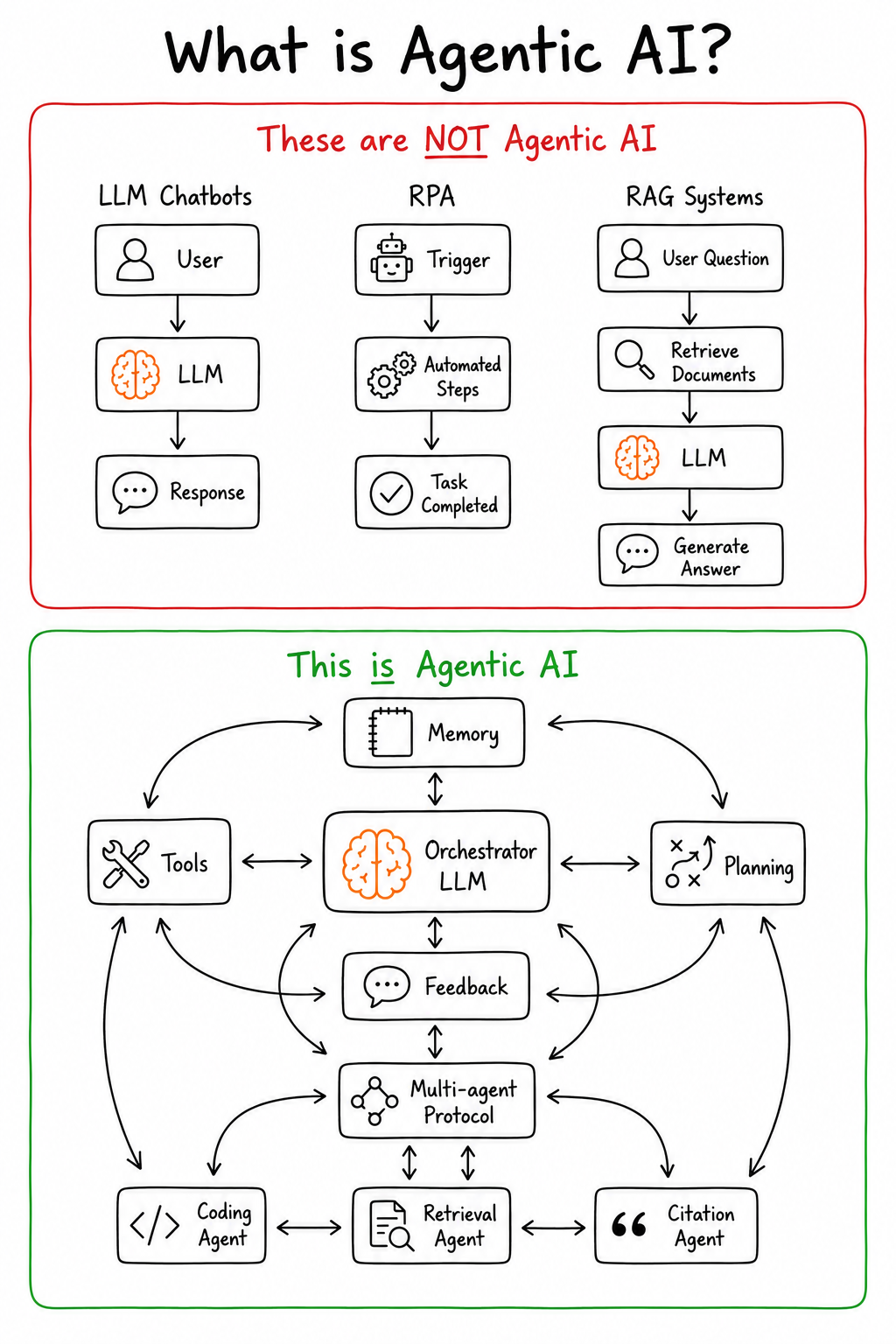
Every Element, Explained in Plain Language
The Orchestrator LLM — The Manager
This is the brain in the middle. When a task comes in, the orchestrator does not execute it itself. It reads the task, breaks it into steps, and decides which tools and agents to use. It coordinates the whole process. Just like a good manager, it delegates rather than does.
Memory — The Notebook
The manager keeps a notebook. Everything that happened in this task so far is written down: what was asked, what was tried, what the result was. Without the notebook, the system would forget everything between steps and have to start over. With it, the work builds on itself.
Tools — What the Manager Can Pick Up and Use
Need to search the web? There is a tool for that. Need to write and run a piece of code? Tool. Need to call an external system or update a database? Tool. The orchestrator reaches for the right tool at the right moment, uses it, and moves on.
Planning — The To-Do List
Before sending work out, the orchestrator thinks about the sequence. What needs to happen first? What depends on what? It builds a small plan and follows it, adjusting as it goes if something does not work as expected.
Feedback — The Quality Check
After each step, the system checks the result. Is this right? Does it make sense? If something looks wrong, it tries again or takes a different approach. It does not just pass bad work to the next step.
Multi-Agent Protocol — The Internal Communication System
When the task needs a specialist, the orchestrator sends it through this coordination layer. It makes sure the right specialist gets the right instructions at the right time, and that results come back in the right format.
The Three Specialist Agents
Coding Agent: writes and tests code. When the task needs something built or automated, this is the specialist that handles it.
Retrieval Agent: goes and finds information. Searches databases, pulls relevant documents, validates what it finds before passing it on.
Citation Agent: makes sure any claim or fact is properly sourced and attributed. It keeps the system honest about where information comes from.
Each specialist is very good at one specific thing. They do not do each other's jobs.
Audit Trail — The Paper Trail
Everything the manager and the specialists do gets logged. What decision was made, when, based on what. If something goes wrong, you can go back and see exactly what happened. This is not just for troubleshooting. It is also how you prove to regulators and auditors that the system behaved responsibly. In the diagram, the dashed border marks it as a control layer, not an execution layer.
Human Above the Loop — The One Who Stays in Charge
Notice the human figure is not inside the process. The human is above it, watching. They set the boundaries before the work starts. They step in when something unusual happens that the system cannot handle. They are not approving every single step. But they are accountable for everything the system does.
This is the most important element in the whole diagram and the hardest one for most organisations to design properly. When the system makes a decision at 2am and something goes wrong, whose number does it come off? That person has to be named before the system goes live. Not after.
The result is a loop, not a line. The system pursues a goal, adapts, delegates, and keeps working until the job is done, or it escalates to a human because it cannot proceed safely on its own.
Why Most Enterprise AI Is Stuck at Stages One and Two
McKinsey is direct on this point: the value at stages one and two is real but not game changing. It will not bring competitive differentiation. The organisations that reach stages three and four are not the ones with better technology. They are the ones that built the foundations first.
Deploying agentic AI safely at enterprise scale requires three things to be in place before the first agent goes live:
- The operating model: the people, literacy, and change infrastructure to work alongside systems that act autonomously.
- The data layer: unified, governed, real-time architecture that agents can read from and write to reliably.
- The governance framework: risk classification, audit trails, action boundaries, and escalation protocols designed before deployment, not after the first incident.
Skipping these foundations and going straight to agentic deployment does not accelerate transformation. It accumulates liability.
Where to Start
The first question is not "how do we deploy agents." It is "what do we actually have in place to support agentic deployment responsibly."
That question has a structured answer. The BAIOS™ Readiness Self-Scan walks you through the five capability areas that determine whether your organisation is ready to move from AI experimentation to AI that creates durable business value.
Strategy comes last. Capability comes first.
Source: McKinsey, Rewired: The McKinsey Guide to Outcompeting in the Age of Digital and AI, second edition, 2026.
Not sure which stage your organisation is actually at?
The BAIOS™ Readiness Self-Scan shows you exactly where you stand across the five capability areas, and what it takes to move from pilots to agentic AI that delivers measurable value.
Take the BAIOS™ Readiness Self-Scan